A 27B Qwen Model on an iPhone Would Change the Local AI Conversation
July 10, 2026
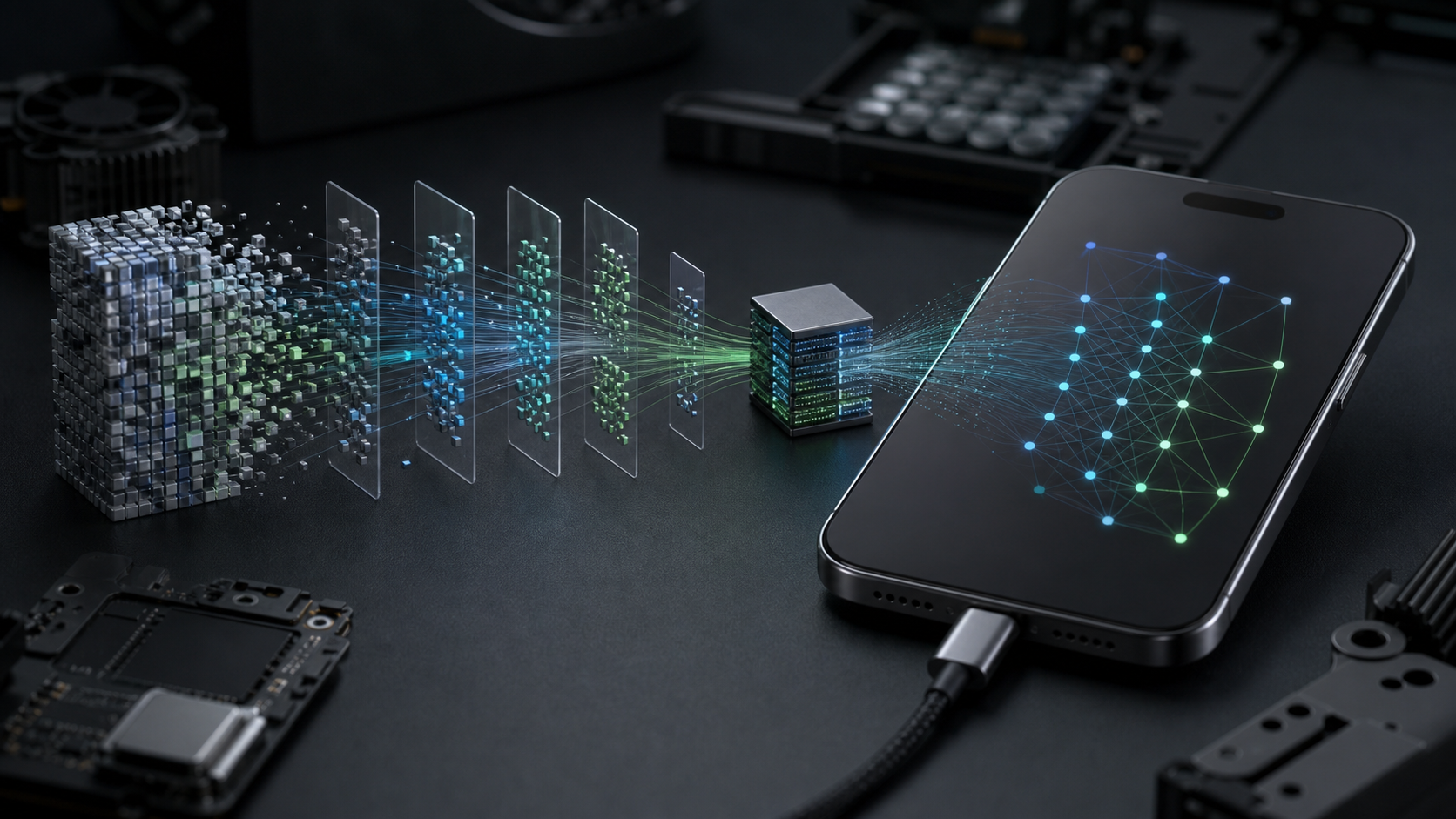
The most interesting local AI news this week is not just that a large model may fit on a phone.
It is what that claim says about the next phase of on-device AI.
PrismML is reported to have compressed Alibaba's open Qwen 3.6 27B model enough to run on an iPhone 17 Pro. The claim is unusually ambitious: not a tiny mobile assistant, not a heavily simplified few-billion-parameter model, but a 27B-class model running locally, with all parameters active.
If that holds up in public testing, it would be a meaningful milestone. It would also force a more careful conversation about what "local AI on a phone" actually means.
The Claim Is Bigger Than Another Mobile Demo
Most phone-side AI today is built around smaller models, sparse architectures, or task-specific systems. That makes sense. Phones have strict limits:
- limited memory
- tight thermal envelopes
- battery constraints
- smaller sustained compute budgets
- less mature local LLM runtimes than desktop GPU stacks
This is why most useful local mobile AI has focused on narrow tasks: summarization, rewriting, image cleanup, photo search, transcription, keyboard suggestions, and lightweight assistant features.
A 27B dense-style local model would sit in a different category. It suggests a phone could handle more serious chat, reasoning, coding, and agent tasks without sending every request to a data center.
That is the important part. The phone would no longer be only an input device for cloud AI. It would become a real inference device.
Fitting Is Only Step One
The most common mistake in local AI is treating memory fit as the finish line.
It is not.
For a phone, there are at least five questions that matter after the model fits:
- How much quality is lost during compression?
- How many tokens per second can it sustain?
- How long can it run before throttling?
- What context length is practical?
- Does it still perform well on real coding, reasoning, and agent tasks?
A model compressed from a large memory footprint to a few gigabytes is impressive. But compression is only useful if the resulting model remains good enough for the task.
This is especially important for coding and reasoning. A small loss in model quality can look acceptable in casual chat but become obvious when the model needs to follow constraints, reason through edge cases, or write correct code.
Why This Matters for Apple
Apple has a strong reason to care about this direction.
Its AI strategy has always leaned toward privacy, device integration, and user trust. Running more intelligence on device fits that philosophy better than sending every request to a remote server.
But there is a hard product gap. The best cloud models are still too large for normal phones, and Apple's most advanced assistant features still need cloud support for difficult tasks.
If compression techniques can make larger open models practical on high-end iPhones, Apple gets several advantages:
- lower cloud inference cost
- faster response for private tasks
- better offline behavior
- stronger privacy positioning
- tighter integration with local files, apps, photos, and settings
The strategic prize is not just "Siri gets smarter." It is a phone that can run useful local agents against your own context, with less cloud dependency.
Full-Parameter Mobile AI Would Change Model Selection
For LocalAIRun, this kind of progress matters because it changes how users should think about model and hardware matching.
Today, model selection usually starts with a hardware ceiling:
- 8GB-16GB memory: small models
- 24GB VRAM: strong 7B-32B quantized models
- 48GB VRAM: 70B-class models become more realistic
- 96GB+ memory: large models and heavier multimodal workflows
Phones have usually lived below that ladder. They were good for small local models, but not serious 27B-class general models.
If a 27B model becomes practical on a phone, the decision tree changes. Users will need to compare:
- phone-local models for private everyday work
- laptop-local models for larger context and better sustained speed
- desktop GPU models for coding, image generation, video, and agent workflows
- cloud models for frontier reasoning and heavy tool use
The future is not one device replacing all the others. It is a tiered local AI stack.
What Still Needs Proof
The reported demo is promising, but the useful version of this story depends on public evidence.
The key proof points are straightforward:
- downloadable model weights or runtime
- reproducible benchmarks
- memory usage during real prompts
- sustained speed over several minutes
- context length under realistic workloads
- comparison against the uncompressed model
- task-level evaluation for coding, reasoning, and agents
Without those details, "runs on iPhone" can mean many different things. It may mean a short demo prompt. It may mean slow but functional inference. It may mean good chat but weak coding. It may mean strong results only under a custom runtime.
That does not make the claim unimportant. It just means the serious local AI community should evaluate it like any other model artifact: with reproducible tests, task fit, and hardware constraints.
The Bigger Direction Is Clear
Even if this specific demo needs more validation, the direction is clear.
On-device AI is moving up the model-size ladder. Hardware vendors are adding more memory and better AI acceleration. Model builders are improving quantization, sparsity, distillation, and compression. Runtime teams are making local inference easier to use.
This is why the next local AI question will not be:
Can my device run AI?
It will be:
Which model class should run on which device, for which task, at what quality and cost?
A phone may handle private chat, short reasoning, voice, and personal context. A laptop may handle daily coding and document work. A desktop GPU may handle larger models, long context, image generation, and agent pipelines. The cloud remains the fallback for the hardest tasks.
That is a healthier view than pretending everything will be cloud-only or phone-only.
The real future is a mix of local and cloud intelligence, with each device running the model that actually fits its job.